Reflections on Writing by an Artist

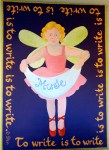
I’m sharing images of artwork by my friend, Kelly O’Brien.  They hang on my wall and sit on my desktop (a real wooden desk-not my Mac) tormenting me. Double click on each image to enlarge.

Posted in Uncategorized | Tagged , , , | 1 Comment

Art vs. Pain

Whether one asks permission beforehand, or forgiveness afterward, the question of art and pain wants attention. Do writers—as artists—have the right to expose secrets and suffering? Does making art excuse or forgive the breach of faith? Are artists somehow a breed apart—not bound by loyalty or decorum? If the work of art is “great” does that excuse whatever pain might have been inflicted in its creation?

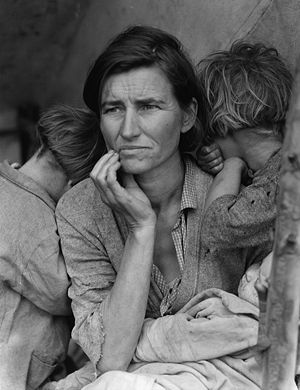
Dorothea Lange is best known for her photograph titled Migrant Mother (1936) of Florence Owens Thompson, a destitute pea picker she met during the darkest days of the Depression. In 1960, Lange gave this account of her experience taking the photograph:

“I saw and approached the hungry and desperate                                                    mother, as if drawn by a magnet. I do not remember how I explained my presence or my camera to her, but I do remember she asked me no questions. I made five exposures, working closer and closer from the same direction. I did not ask her name or her history. She told me her age, that she was thirty-two. She said that they had been living on frozen vegetables from the surrounding fields, and birds that the children killed. She had just sold the tires from her car to buy food. There she sat in that lean-to tent with her children huddled around her, and seemed to know that my pictures might help her, and so she helped me. There was a sort of equality about it.”

(Lange, “The Assignment I’ll Never Forget: Migrant Mother,” Popular Photography, February 1960)

It is reported that Lange always asked permission before she took a picture. For many artists, asking permission isn’t important. Or even considered. Especially those who believe, as did William Faulkner: “the writer’s only responsibility is to his art…If a writer has to rob his mother, he will not hesitate; the ‘Ode on a Grecian Urn’ is worth any number of old ladies.”

Faulkner’s casual disregard for consequences sidesteps reality. Whether the writer is telling secrets or simply stating the facts as she understands them to be, there is always action and reaction. The thing done cannot be undone. A work such as Mary Karr’s Liar’s Club (Penguin Books, 1995) lays bare the rawest truth. The sweeping up is someone else’s task.

And yet: Anticipating reaction often stops writers cold and in doing so, derails the art.

I’ve struggled with these questions in my own work and I’ve come to believe that there is no absolute. “Situational ethics” is a slippery slope…but here I think it applies. The writer must ask his or her motives and must admit the many (and contradictory) forces that forge any important decision.

This blog post includes a clip from an interview with the writer, Michael Sinclair. He’s a poet, fiction writer and visual artist living in Iowa. By way of disclosure, I’ve known Mike more than 20 years. His work can steal my breath away. He came face to face with action/reaction after writing a poem. His hard-earned insight holds hard facts.

You can read more from Mike at his blog: http://web.me.com/prairiewolfpress/Prairie_Wolf_Press/W._Michael_Sinclair/W._Michael_Sinclair.html

Posted in Uncategorized | Tagged , , , , , , , , , | 2 Comments

Reading and Writing

The St. Louis Art Museum in Forest Park. It’s one of my favorite places. And even though the current construction has me confused and resentful, I continue to go for all the things I love about being there: the art of course, but also the scent of water on stone in the museum’s great hall…the views through the windows in every season, the luxury of lingering over coffee in such a beautiful space. I also sometimes go there to draw.       More than once I’ve been 20 minutes into my copy only to discover something entirely new: a broad band of color, or a figure in the shadows that I’d always missed—until I stopped to study the work.

This idea of lingering over a work is taken up by Francine Prose (Atlantic Magazine Interviews: “Reading and Writing” —July 18, 2006). I include the link below and encourage you to read it,  as much for her terrific insights as for her clear, concise language. Close reading, as Prose points out, affords deeper understanding of a work.      It is also essential practice for a writer.  When I read lines that make me laugh out loud (David Carkeet’s recent novel, From Away),  or imprint a character on my brain (Lorrie Moore’s Gate at the Stairs), or that keep me reading well past midnight (Charles Dickens, Great Expectations; Alexandre Dumas, The Three Musketeers), I know I am in the hands of a master. And I know that I will read—and re-read—those passages so that I might understand, and learn….and in the process, make my own work better.

The Atlantic __ Magazine __ Close Reading

Posted in Uncategorized | Tagged , , , , , , , | Leave a comment

On Seeing the AIDS Quilt at the Field House

This room is too colorful.
A gathering of fabric tombstones
Cotton, satin,
Sequins,
Photographs under vinyl.

Each quilt is
A bon voyage
When get well wouldn’t do.
People come, place pale carnations
Done up in green paper
From the grocery store.
Cry
And leave.

Like some weird religious sect,
Attendants
Shrouded all in white
Replace the stock of tissues.
They read names over loudspeakers
Taking turns
With the women’s chorus.

The dying loved their pets,
They posed with them.
One
Walked with his Boston terrier
Through blue paint
Then headed diagonally north,
Left only a photograph of the two of them
And those blue foot falls.

Posted in Uncategorized | Tagged , , | Leave a comment

Anenepost 1: July 12, 2010

I have always valued ceremony. Believed that some designated hour or day—say midnight on New Year’s Eve, or the morning of my birthday—might usher in a whole new me. I am embarrassed to count the decades this thinking had me. I’ve certainly lost track of the hours and days and events I hoped would do. But a life spent waiting is a shadow life.

A distraction that diverts as the real thing passes by.

There’s a poem by Eleanor Lermin called Starfish (from Our Post-Soviet History Unfolds, 2005), that I like—the first stanza especially. It reads:

“This is what life does. It lets you walk up to
the store to buy breakfast and the paper, on a
stiff knee. It lets you choose the way you have
your eggs, your coffee. Then it sits a fisherman
down beside you at the counter who says, last night
the channel was full of starfish. And you wonder,
is this a message, finally, or just another day?”

At 56, I’m working to finish my first novel. It’s been accepted for publication by Blank Slate Press. Even as I write this, my fingers do a shy dodge on the keys, as if to warn me off the telling, lest I tempt the furies, or wake myself from this dream—this thing I always wanted. This chance.

My magical thinking is not dismissed so much as redirected. There was no circled date on a calendar, no ritual of preparation. There was, instead, an email. An email I could have missed. It announced a gathering. Followed by a lunch.  And a question: “Do you have a manuscript you’d like to share?” And I went reckless: sent out the work I had not finished, but could not leave. Life is more slippery than we dare to know. It is not enough to wait for life to happen.

Nor is it enough to write a novel. Writers must market too. And so, on the advice of Blank Slate Press, I’ve begun this blog. I want to be clear: This is my very first blog entry—ever. I’m not a person who sends instant messages, or texts. I do not add comments to online posts. My cellphone doesn’t have a camera. Truth told, when not traveling for business, I may go two weeks and not bother to turn it on.

It’s not that I don’t value technology: I spend hours each day on a computer. I am in awe of the Internet. And a week-long hike in Yosemite a few years back gave me a renewed appreciation for the conveniences of urban life. But I believe that much of this technology is distraction. In the extreme, our devices not only take us away from one another, but away from ourselves.

Yet, in this world of noise and clutter, I still want to be heard. So I’m adding my clicks to the cacophony to make my case.

In this blog I’ll focus mostly on writing. I’ll share work and resources that I find valuable. And I welcome input from you.

For years I’ve tortured myself at writers’ readings—hardly daring to ask what I most want to know: What is it like? How do you do it? What can you tell someone starting out? I’ll tell you the answers from my own experience. And I plan to find writers who will share their insights too.

I would rather you know me through my writing. Because in my writing you will find my truest self. The self that sees the world a particular way—a self changed by that experience.

There are starfish in the channel. This is not “just another day.”

Posted in Uncategorized | Tagged , , | 8 Comments